Job-Site Acclimation of Tropical Hardwood: How Long, How, and Why
Acclimation: The Step Impatient Crews Skip
Tropical hardwood arrives at the job site with a moisture content set by the mill's kiln schedule and weeks of transit conditions — not by your local climate. Installing boards before they equilibrate to the site environment locks in future movement as gaps, cupping, or buckling.
The Science in One Paragraph
Wood constantly exchanges moisture with the surrounding air until it reaches equilibrium moisture content (EMC). EMC varies by region and season: roughly 12–14% in the humid Southeast, 6–9% in the arid Southwest, 11–13% in the coastal Northwest. Kiln-dried tropical decking typically ships at 12–18% MC. The gap between arrival MC and local EMC determines how much the boards will move after installation — unless you let them move before installation.
The Acclimation Protocol
Duration: Minimum 7 days on site; 14 days is better for arid climates or air-dried stock. Verify with a moisture meter rather than trusting the calendar — acclimation is complete when readings stabilize within 2% of local EMC.
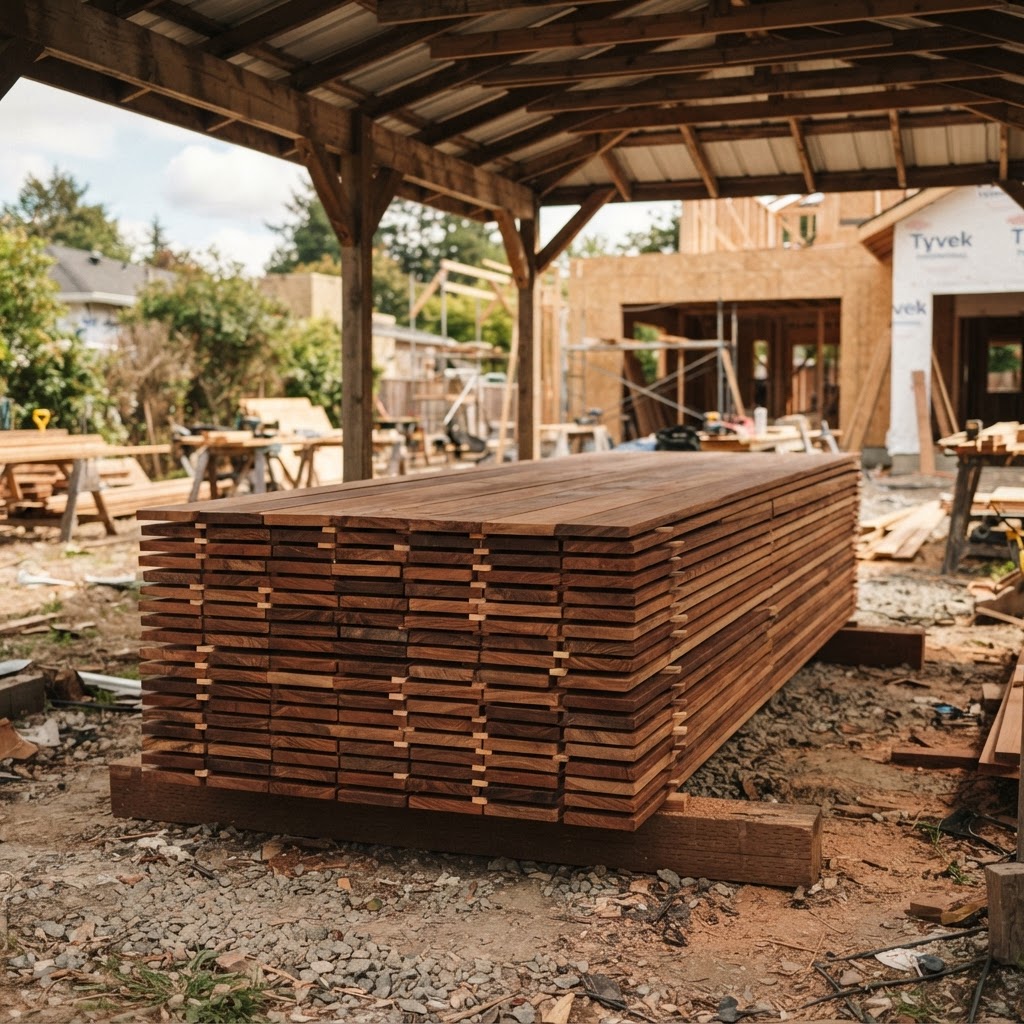
Stacking: Sticker-stack the boards — horizontal layers separated by 3/4" spacers (stickers) every 24", aligned vertically. This exposes all four faces of every board to airflow. A dead-stacked bundle acclimates only its outer boards.
Location: Acclimate in conditions matching the installation environment — outdoors, shaded, protected from rain and direct sun. Acclimating boards in a garage or conditioned space defeats the purpose.
Elevation: Keep the stack at least 4" off the ground on level supports. Ground contact wicks moisture into the bottom layers.
Cover: Top cover only (plywood or a tarp tented for airflow) — never wrap the stack in plastic, which traps moisture and can promote surface mold.
Moisture Meter Practice
Use a pin meter with species correction (dense tropical species read differently than the meter's default calibration — consult the meter's species chart, or apply the manufacturer's correction factor). Measure a sample of boards from different stack layers, at mid-length and near ends. Record readings — documentation of pre-installation MC is your defense if movement is ever disputed.
What Skipping Acclimation Costs
- Boards installed wet into a dry climate shrink: gaps widen from 3/32" to 1/4"+, fasteners loosen
- Boards installed dry into a humid site swell: boards bind, cup, and in tight installations can buckle upward
- Warranty claims for movement-related failures are routinely denied when the installer cannot document acclimation
The Bottom Line
Acclimation costs nothing but schedule awareness — order material two weeks before the install date. It is pure risk elimination, and it separates certified professionals from crews that install straight off the truck.
Related Articles
Why We're Requiring Stainless Steel Fasteners in All Level 1 Curriculum
After reviewing five years of field data, EHCI has updated its core curriculum to mandate stainless steel fastener knowledge. Here's the reasoning.
Don't Just Take Their Word For It: The Power of Credential Verification
Verifying installer credentials is quick, free, and essential. Learn how EHCI's verification tool protects homeowners and upholds industry standards.
The Foundation of Trust: EHCI's Commitment to Professional Standards
EHCI's Code of Conduct and Certification Standards ensure every certified professional upholds the highest levels of craftsmanship and integrity.