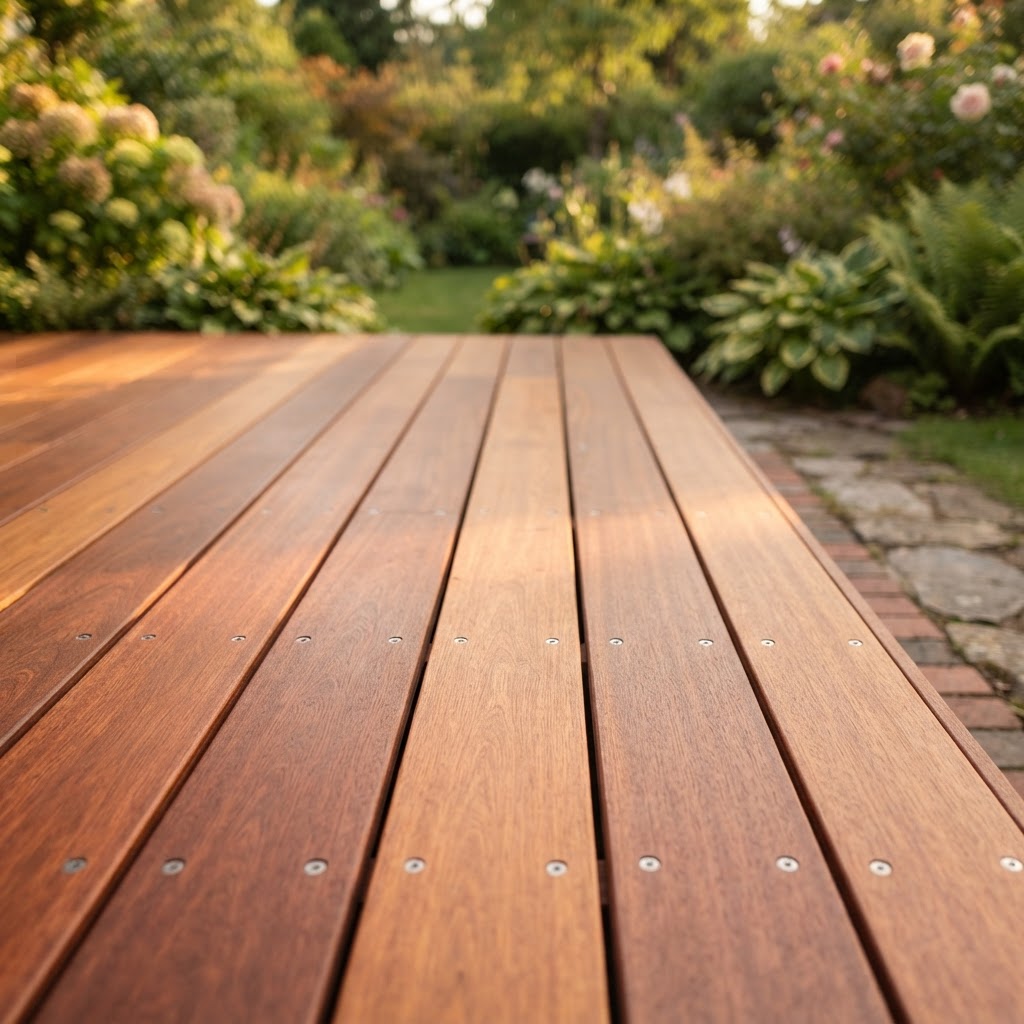
Red Balau (Batu): The Budget-Friendly Tropical Hardwood Worth a Second Look
Red Balau (Batu): The Value Play in Tropical Decking
Red Balau — marketed widely under the trade name Batu — is a Shorea-genus hardwood from Southeast Asia that has quietly become one of the best value propositions in exterior hardwood. It won't dethrone Ipe, but for budget-conscious projects that still demand real hardwood performance, it deserves serious consideration.
Technical Properties
- Janka hardness: ~1,600–1,900 lbf (vs. Ipe ~3,500, Cumaru ~3,300, Garapa ~1,700)
- Bending strength (MOR): ~13,000–16,000 psi
- Density: ~50–55 lbs/ft³
- Durability class: 2 (durable) — 25+ year expected service life above ground
- Color: Consistent reddish-brown to mahogany tones, notably uniform across boards
Where Red Balau Shines
Color consistency: Batu's most underrated trait. Ipe boards vary from olive to chocolate; Batu arrives remarkably uniform, which matters for design-driven clients and reduces sorting labor.
Workability: At roughly half of Ipe's hardness, Batu is dramatically easier on blades, bits, and crews. Pre-drilling is still required, but cutting and machining feel closer to working white oak than working Ipe. Labor hours drop measurably.
Stability: Good dimensional stability with predominantly interlocked grain. Cupping and checking behavior is well-mannered when installed with proper ventilation and acclimation.
Price: Typically 30–45% below Ipe, and often below Cumaru and Tigerwood as well.
Where It Falls Short of Ipe
- Surface hardness: 1,600–1,900 Janka resists normal traffic well, but shows furniture dents and impact marks that Ipe would not
- Fire rating: Does not achieve Ipe's Class A flame spread in most assemblies — relevant for rooftop and WUI (wildland-urban interface) specifications
- Marine/ground contact: Class 2 durability is not sufficient for dock decking or ground-contact use where Class 1 species are indicated
- Tannin bleed: Moderate — expect some initial extractive bleed on light-colored surfaces below, similar to Cumaru
Installation Notes
- Pre-drill everything — interlocked grain splits at edges without pilot holes
- Stainless steel fasteners only (Type 305 minimum; 316 coastal) — Batu's tannins react with plain and galvanized steel exactly as Ipe's do
- Standard gapping — 3/32" to 1/8" at typical installed MC; acclimate 7–14 days
- End-seal all cuts — Batu end-checks readily without sealing, more so than Ipe
- Finish: Takes penetrating oil beautifully and evenly; its uniform color makes finish results more predictable than most tropical species
The Sourcing Caveat
"Balau" covers a broad group of Shorea species, and quality varies by mill and country of origin significantly more than with Ipe. Buy from suppliers who specify Red Balau, provide grading documentation, and stand behind kiln-drying claims. Verify FSC or equivalent chain-of-custody where the project requires it.
The Verdict
For residential decks, fencing, and cladding where the budget won't reach Ipe, Red Balau is the honest recommendation — real tropical hardwood performance, uniform appearance, easier installation, and a service life measured in decades. Know its limits (fire rating, marine use, impact hardness), specify it where those limits don't apply, and it will make both the client and the crew happy.
Related Articles
Thermally Modified Wood vs. Tropical Hardwood: An Honest Technical Comparison
Thermally modified ash and pine are marketed as sustainable alternatives to tropical hardwood. Here's how they actually compare on durability, stability, and structural performance.
Ipe vs. Cumaru: A Side-by-Side Comparison for Deck Builders
Both species are exceptional for exterior use, but they're not interchangeable. Here's what every installer should know before quoting a job.
Garapa: The Underrated Species That Deserves Your Attention
While Ipe gets all the headlines, Garapa offers a compelling value proposition that more contractors should be talking about.