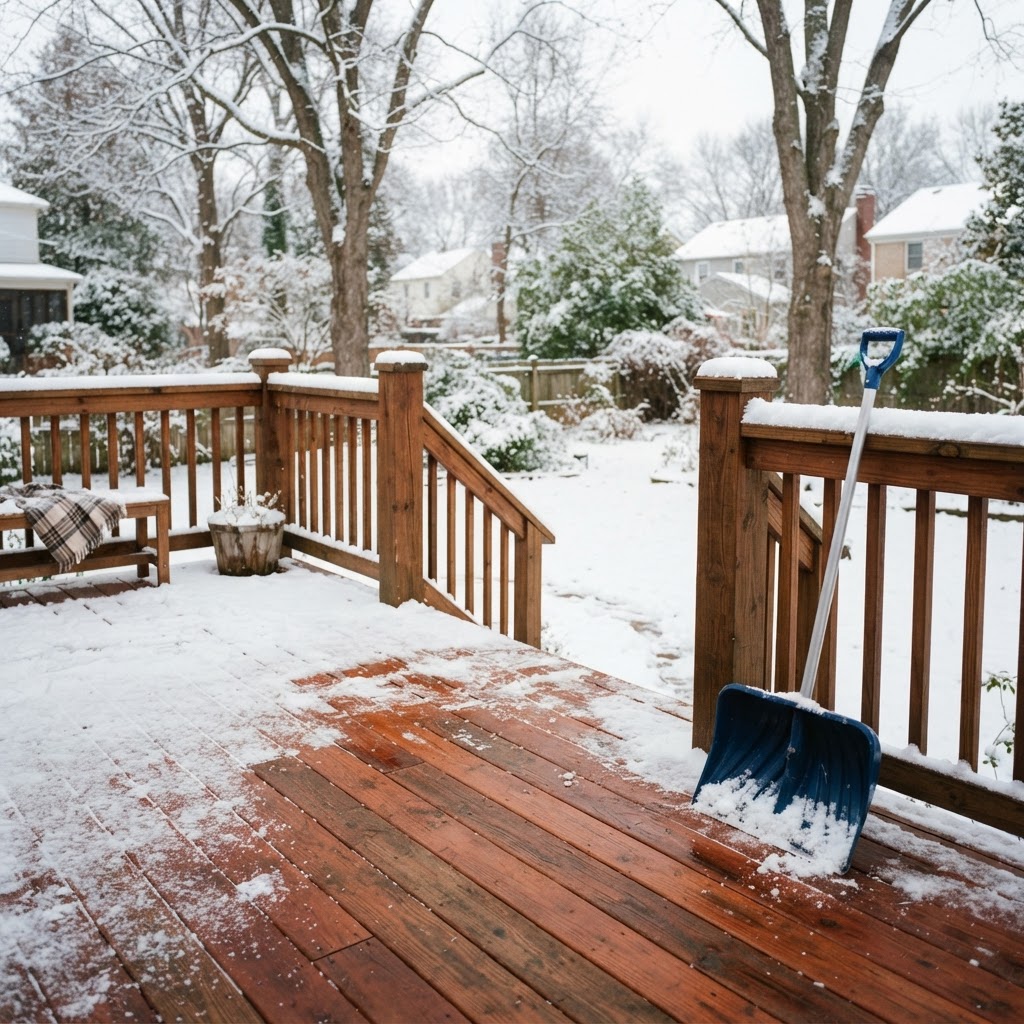
Snow, Ice, and De-Icing Salts on Hardwood Decks: A Winter Care Guide
Winter and Your Hardwood Deck: What Actually Causes Damage
Dense tropical hardwoods like Ipe and Cumaru perform exceptionally well in freeze-thaw climates. Their low porosity means minimal water absorption, which means minimal ice-expansion damage within the wood itself. Most winter deck damage isn't caused by winter — it's caused by winter maintenance.
Snow Removal: Tools Matter
Use: A plastic-edged snow shovel or a stiff push broom, worked parallel to the deck boards (with the grain, along the gaps).
Never use: Metal shovel blades, ice choppers, or metal-edged scrapers. Even Ipe scratches under a steel edge dragged across frozen fibers, and every scratch is a foothold for moisture and UV degradation.
Snow blowers: Single-stage units with rubber paddles are acceptable on decks rated for the equipment weight. Two-stage units with steel augers are not.
Light snow can simply be left to melt — snow sitting on a hardwood deck causes no harm. Clear pathways for safety, not for the wood's sake.
De-Icing Products: The Real Threat
Rock salt (sodium chloride) is the worst common option: it leaves white residue in the grain, dehydrates surface fibers, accelerates corrosion of any metal within splash distance (fasteners, railing hardware, door thresholds), and burns nearby plantings in spring runoff.
Calcium chloride and magnesium chloride are less damaging to wood but still corrosive to hardware over repeated seasons.
Better options for hardwood decks:
- Sand or fine gravel for traction — zero chemical impact, sweeps off in spring
- Calcium magnesium acetate (CMA) — the least corrosive commercial de-icer; more expensive, worth it around stainless hardware
- Rubber-backed outdoor mats on high-traffic paths — remove them in spring to prevent moisture trapping
If any de-icer is used, rinse the deck thoroughly during the first thaw above 40°F.
Pre-Winter Preparation Checklist
- Clean the deck in late fall — organic debris (leaves, needles) trapped under snow all winter promotes surface mildew and staining
- Clear the gaps — debris packed between boards blocks drainage and holds meltwater against board edges
- Confirm drainage below — meltwater must exit the substructure area; ponding under a deck in winter means saturated posts in spring
- Skip fall oiling in most climates — finish applied just before months of snow cover weathers unevenly; spring application after cleaning gives a full season of protection
Spring Inspection
When the deck is fully dry after thaw: sweep, wash, inspect fasteners (freeze-thaw cycling can back screws out fractionally), check for scratches from winter traffic, then clean and re-oil as part of normal annual maintenance.
A hardwood deck in Minnesota, treated correctly, will outlast the same deck in San Diego treated carelessly. Winter isn't the enemy — steel shovels and rock salt are.
Related Articles
Best Hardwood for Decking: 7 Species Compared
Compare Ipe, Cumaru, Garapa, Tigerwood and more on density, durability, stability and cost to choose the best hardwood for your deck.
Ipe Decking Cost Per Square Foot Installed (2026)
Typical installed Ipe decking cost per square foot, what drives price, and how to get a fair quote from a qualified installer.
The Hidden Cost of Uncertified Installation: A Homeowner's Cautionary Tale
When a homeowner in Tampa chose the lowest bidder for their Ipe deck, they saved $2,000 upfront—and spent $14,000 fixing it.